Abstract:Japanese Ikebana and FX are totally irrelevant two things, however, if we look at them by mathematical thinking, we will find that they are surprisingly similar in logic.
Japanese Ikebana and FX are totally irrelevant two things, however, if we look at them by mathematical thinking, we will find that they are surprisingly similar in logic.
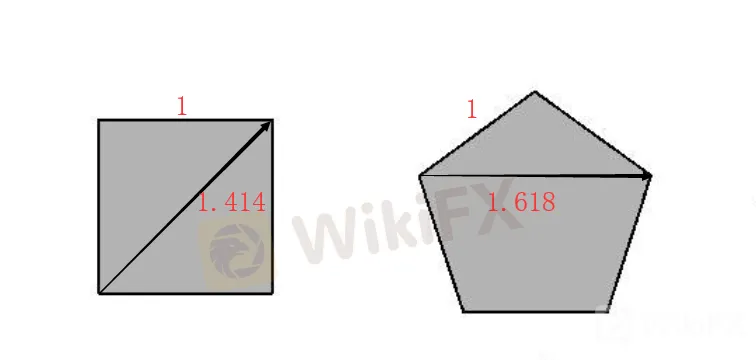
Silver ratio is widely used in Japanese Ikebana, as golden ratio is well known by FX dealers. The following picture can help you quickly get idea what silver ratio and golden ratio are. The ratio of the diagonal to the side length of a square is silver ratio, that is 1:1.414 = 1:√2 = 0.707
The ratio of the diagonal to the side length of a Pentagon is golden ratio, that is 1:1.618 = 1: ((√5-1)/2) = 0.618
Many people think that Japanese Ikebana is a perceptual world, which cannot be explained by theory. In fact, professional florists always create works based on logical thinking, the length of flower branches, the angle of insertion, the orientation of flowers and leaves, all have reason to follow.
Although the division of Japanese Ikebana is very complicated, but nearly all Ikebana genres are evolved from three oldest genres, which are Ikenobo, Sogetsu and Obara. Form of flower arrangement is an important element to distinguish different genres. Tachibana, Ikebana, Moribana and Jiyuuka are main forms of flower arrangement, since the last two were influenced by western plants and flower arrangement techniques, so the first two forms, Tachibana and Ikebana are considered to be more able to reflect the traditional Japanese flower arrangement techniques and aesthetic consciousness.
Here take Misho-ryu as example, whose main essentials are ratio of main flower branches should be trimmed to 1: √ 2, angle of insertion should be 30 ° to 45 °, direction of flower should be turned by 20 ° to 30 ° and so on...
As a whole, the flower branches are framed as equilateral right triangle.

The highest branch is called “Sky”; the middle branch is “Human” and the lowest branch is “Earth”; the length of the branches is determined by silver ratio:
Human: Heaven=1: √ 2
Earth: Human =1: √ 2

According to florists, if length of branches is cut by golden ratio, longer branch will be unstable, thus golden ratio is considered to be a dynamic proportion. Fixing flower posture by silver ratio can better show flowers mysterious life to people in a stable and static form. Even there is warm emotion in heart, it should also be shown in conservative and implicit way, which is exactly Japanese aesthetic consciousness.
If we say that Ikebana is a static world, trading should be considered a dynamic world where price changes every second. The golden ratio, this dynamic proportion in the eyes of florists is used widely by FX dealers for trading.
On the monthly chart of NASDAQ, we can see that price slumped twice to the position of 0.618.
BC/AB=0.618
DE/AD=0.618

Golden ratio appears not only in price space, we can find its effectiveness in the field of time space.
On the weekly chart of gold, time interval between each trends up and down is very close to golden ration, that is 0.618:
5/8=0.625
8/13=0.615
13/21=0.619
21/34=0.617

Besides trading and flower arrangement, gold ratio can be found in many western buildings too, like aspect ratio of Ancient Greek Acropolis Temple, while silver ratio widely exists in traditional Japanese temples and many other things.
Can we draw a conclusion that golden ratio is the beauty of the West, while silver ratio is beauty of Japan?







