


FCA Warning Capital Zodiac 7 September 2026 and Seven Checks Before Paying
The FCA named Capital Zodiac as an unauthorised clone on 7 September 2026. Check capitalzodiac.com, capitalzodiac.net and FRN 806702 before paying.
Original

简体中文
繁體中文
English
Pусский
日本語
ภาษาไทย
Tiếng Việt
Bahasa Indonesia
Español
हिन्दी
Filippiiniläinen
Français
Deutsch
Português
Türkçe
한국어
العربية
اردو




Abstract:Predictions for the US non-farm payrolls: Ugly leading indications have traders on edge
Click Here: After you read it, Daily Routine with WikiFx
Find out what the leading indications indicate about this month's NFP data and how you may trade it!
In his press conference on Wednesday, Fed Chairman Jerome Powell stated that the US job market “remains extraordinarily tight” and that “[the Fed] must bring down inflation” to sustain the labor market. In other words, the central bank is happy with its “employment” mandate but worried about its “inflation” component.
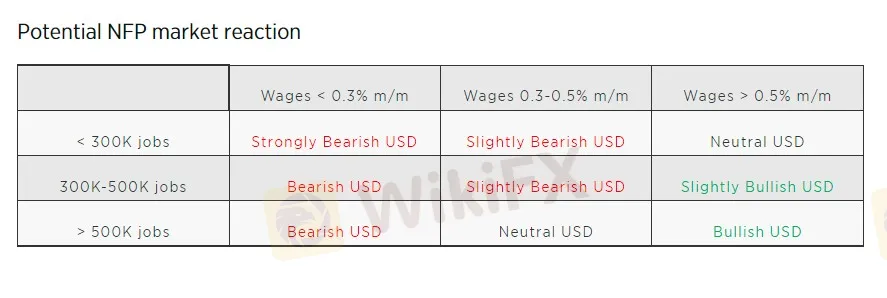
In this context, it will be interesting to monitor how employment figures evolve in the next months as financial conditions (read interest rates) change. Thankfully, analysts don't expect that to be a large role in this month's NFP report, with consensus predictions of 400K net new jobs and a 0.4% increase in average hourly earnings:
The market reaction to this month's jobs data may be less than last month's, but it's still worth watching how the report comes in relative to market expectations.
Are these hopes valid? Onward to Friday's vital jobs report!
NFP outlook
To forecast each month's NFP data, we use four historically accurate leading indicators:
The ISM Services PMI Employment component fell to 49.5 from 54.0 previous month, indicating a substantial decline in service sector employment.
The ISM Manufacturing PMI Employment component fell to 50.9 from last month's 56.3.
247K net new jobs were reported by ADP, considerably below projections and well below last month's revised 479K.
Finally, the 4-week moving average of initial unemployment claims jumped to 188K from 178K last month.
Remember that the US labor market is still recovering from the unprecedented disruption caused by the COVID outbreak. But analyzing the data and our internal models, the leading indicators point to this month's NFP report showing somewhat below-expected employment growth of 300-400K, albeit with a larger spectrum of uncertainty than previously given the present global context.
Regardless, the month-to-month fluctuations in this report are notoriously difficult to forecast (including ours). These are always closely followed by the average hourly wage, which rose by 0.4 percent m/m in the latest NFP data.
The US dollar index rose to near 20-year highs above 103.00 last month, but Fed Chairman Powell's more cautious-than-expected comments have halted the advance so far this week. Macroeconomically, a strong NFP data may be required to boost the greenback to fresh highs.
For potential trade setups, consider buying USD/JPY after a solid NFP data. After a week of controlled declines (potential bullish flag formation), the medium-term momentum remains bullish.
A weaker jobs data may give a buy opportunity in AUD/USD. With the Aussie forming a “higher low” in the mid-0.7000s, the pair could continue its gains into 0.7300 if traders elect to take profits on the (US) dollar ahead of the weekend.
Disclaimer:
The views in this article only represent the author's personal views, and do not constitute investment advice on this platform. This platform does not guarantee the accuracy, completeness and timeliness of the information in the article, and will not be liable for any loss caused by the use of or reliance on the information in the article.

The FCA named Capital Zodiac as an unauthorised clone on 7 September 2026. Check capitalzodiac.com, capitalzodiac.net and FRN 806702 before paying.

This WEALTH-FX review starts with a licensing statement that needs verification. The client agreement on wealth-fx.com says the company is incorporated in St. Vincent and the Grenadines as 88102 LLC 2021 and is authorised and regulated by the SVG FSA. An official SVG FSA notice, however, says forex trading brokerage activities are not licensed in that jurisdiction. The same agreement separately names WealthFX Liquidity Limited, company 180782, and describes a Mauritius International License. For an India-based reader, those website claims do not replace RBI rules for permitted forex transactions or an independently confirmed licence record.

Did ePlanet, a Comoros-based brokerage, allegedly withhold your dollars on the platform? Did the broker prevent you from accessing the ePlanet login dashboard upon a withdrawal request? Did the broker platform execute trade orders slowly? Have you faced losses due to slippage? This ePlanet review 2026 evaluates user claims while also providing a regulatory overview of the broker.

FCA warns EXOTICINVEST in a notice first published and updated on 3 September 2026. The UK regulator identifies EXOTICINVEST TRADING AND INVESTMENT FIRM and the website www.exoticinvest.ltd, stating that the firm is not authorised and may be targeting people in the UK. This is a dated regulatory warning, not a customer review or a confirmed loss report. Anyone approached through the named website should stop before paying, avoid sharing login credentials and verify the exact business independently through the FCA Firm Checker.
WikiFXWikiFXWikiFXWikiFXWikiFXWikiFXWikiFXWikiFXWikiFXWikiFX