


IG Review for India 2026: RBI Alert List, Regulation, Login, and Forex Risk
IG review for India in 2026: see the RBI Alert List entry, overseas regulation, login checks, forex limits, and a clear broker safety checklist.
Original

简体中文
繁體中文
English
Pусский
日本語
ภาษาไทย
Tiếng Việt
Bahasa Indonesia
Español
हिन्दी
Filippiiniläinen
Français
Deutsch
Português
Türkçe
한국어
العربية
اردو




Abstract:The three generally accepted methods of analyzing the financial markets are: technical, fundamental, and sentimental. Choosing which one to use is a matter of personal preference that develops from study and practice.
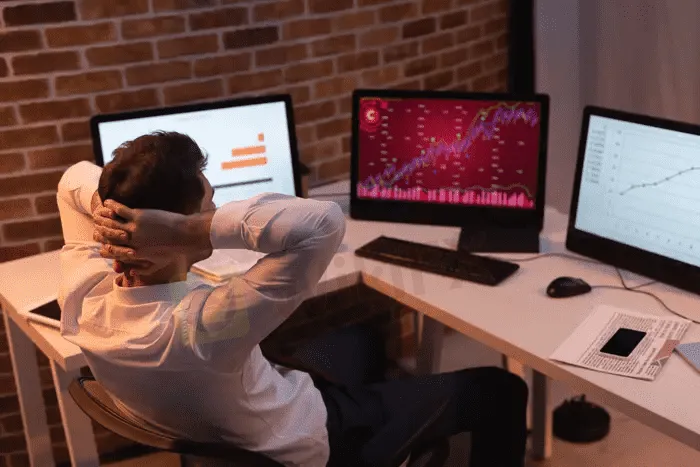
Technical analysis is the study of trading activity through the use of patterns, trends, price movement, and volume. Fundamental analysis is the study of price movement to determine the value of an asset. Sentimental analysis is feeling the tone of the market through the study of crowd psychology.
Each of these methods of looking at an assets value has its merits and no one of them is complete on its own. Still, with some types of trading, you will want to rely more heavily on one type of analysis than another in order to better control the risk.
Technical analysis differs from fundamental and sentimental analysis in that it only takes into account the price and volume of an asset.
The core assumption is that all known fundamentals are factored into price; thus, they become irrelevant and there is no need to pay close attention to them.
The technical trader is not attempting to measure the assets intrinsic value, but rather trying to use technical analysis tools like chart patterns, oscillators and trends to determine what an asset will do in the future.
Fundamental analysis relies on macro-and micro-economic factors to determine the long-term and short-term value of an asset. Fundamental analysis looks at the factors that cannot be measured in a price chart. Some of these factors include supply/demand, economic strength, and economic growth.
Sentimental analysis has often been described as “reading the news”. However, it is probably closer to “reading the price action”. This is because something reading the headlines can fool a trader. Therefore, sentimental analysis works better over the short run with technical analysis, but over the long run, fundamental analysis will likely override any short-term sentimental biases.
Trading with sentimental analysis alone can be effective, but you need to be patient when you utilize this method. News does not happen every day for every asset. If you specialize in currencies, for example, you might only be making a couple of trades per week.
Every trader will have a slightly different way of analyzing their assets of choice, and this is okay.
Some traders refer to themselves as pure technical traders and choose to ignore the fundamentals completely. They rely on statistical confidence in trading signals and assume the fundamentals have been priced into their analysis.
Fundamental traders tend to develop a bias in a market based on the macro-economic or long-term fundamentals then make adjustments to the microeconomic or short-term fundamental news.
Sentimental traders tend to react to the headlines and trade the momentum based on the news. This implies that a sentimental trader leans toward the technical side since momentum refers to price action.
A sentimental trader is linked to the fundamental side of the equation because the best momentum-generating headline is often caused by a surprise in the news. In order to be surprised by the news, one has to know the fundamental expectations ahead of a report, for example.
There is no one way to trade that is better than another. However, when measuring trading risk, technical analysis is probably the best tool to use. Furthermore, when building a trading system, technical analysis is probably best because of the plethora of statistical tools available to back-test trading theories.
Its difficult to measure the success of fundamental analysis over the short run because it takes a long-time for a major fundamental event to develop. Think about how difficult it is to trade central bank activity over the short run. Then think about how much easier it is once a central bank decides to loosen or tighten policy.
Sentimental analysis is primarily used by the trader who likes action. The sentimental trader often has an indication of what the fundamental report is expected to show then reacts to whether the report is above or below expectations. Furthermore, the trader likely takes a peek at the chart to determine the momentum of the price action. In this case, its safe to say the sentimental analysis trader is more likely to use a blend of technical and fundamental analysis.
Many people thrive on short-term trades, but just as many need to trade longer-term in order to be successful. A well-rounded approach will utilize both time frames and will also use all three types of analysis.
You‘ve probably heard the popular phrase about how you shouldn’t keep all of your eggs in one basket. This is a fancy way of saying you shouldnt rely solely on one method for success. This suggests that trading a blend of technical, fundamental, and sentiment analysis may be the best approach with more control over risk.
Trading is a high-risk activity any way you look at it and you will want to reduce that risk for long-term success. A little bit of short-term trading plus a little bit of long-term trading will be your best choice for sustained results. Just like blending a little technical analysis with a little fundamental analysis.
Meanwhile, if you like trading the action then sentimental trading is probably the best, provided you use technical chart points to control the risk.

Disclaimer:
The views in this article only represent the author's personal views, and do not constitute investment advice on this platform. This platform does not guarantee the accuracy, completeness and timeliness of the information in the article, and will not be liable for any loss caused by the use of or reliance on the information in the article.
IG review for India in 2026: see the RBI Alert List entry, overseas regulation, login checks, forex limits, and a clear broker safety checklist.

Orbex, a Cyprus-based brokerage entity, has recorded 30 exposure complaints on WikiFX, a leading forex broker regulation inquiry tool, so far. Other review websites have also recorded a healthy number of complaints against the brokerage firm. These complaints largely talk about the alleged profit confiscations by the broker in the name of trading violations, difficulty in accessing fund withdrawals, capital losses due to artificial slippage, etc. In this Orbex review, we have investigated user complaints and provided a regulatory overview of the broker.
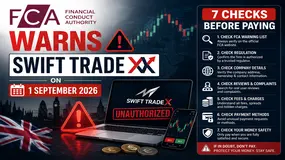
FCA warns Swift TradeX in a notice first published and updated on 1 September 2026. The UK Financial Conduct Authority says the firm may be providing or promoting financial services without permission, is not authorised, and may be targeting people in the UK. The notice names the website swifttradexai.com, a Worcester address and a UK telephone number, but also cautions that unauthorised businesses may use incorrect or borrowed contact details. The confirmed issue is authorisation status—not a court finding about every transaction. Anyone considering a payment should stop, verify the firm independently, and avoid using contact information supplied by the platform itself.
ThinkMarkets review for India: check the RBI Alert List, overseas entities, regulation, login security, forex rules, costs, withdrawals, and leverage risk.
WikiFXWikiFXWikiFXWikiFXWikiFXWikiFXWikiFXWikiFXWikiFXWikiFX