


UK Retail Sales July 2026 Fall 0.5%: What the Result Means for GBP
UK retail sales fell 0.5% in July 2026, while the three-month measure rose 1.1%. See the ONS details and what the mixed result may mean for GBP.
Original

简体中文
繁體中文
English
Pусский
日本語
ภาษาไทย
Tiếng Việt
Bahasa Indonesia
Español
हिन्दी
Filippiiniläinen
Français
Deutsch
Português
Türkçe
한국어
العربية
اردو




Abstract:According to the Centre for Promotion of Private Enterprise (CPPE), ability to maintain and generate new jobs has been seriously threatened by the country's FX shortage. The profitability of investments in the first half of 2022 has been negatively impacted by the steep depreciation and the operation of the parallel market, which has increased by over 300 percent as a result of the official window's shortage.

According to the Centre for Promotion of Private Enterprise (CPPE), ability to maintain and generate new jobs has been seriously threatened by the country's FX shortage.
The profitability of investments in the first half of 2022 has been negatively impacted by the steep depreciation and the operation of the parallel market, which has increased by over 300 percent as a result of the official window's shortage.
These have impact on enterprises in all economic sectors. Because of operating and manufacturing costs have increased by 30 to 100 percent, he claimed.
He pointed out that many industries' outputs had many raw materials problems due to a lack of available foreign currency, and that many players in the economy now turned to the parallel market for patronage because there was so little access to it on the official window.
According to him, the country's capital inflows by the dysfunctional foreign currency policy, has an effect on foreign direct investment and foreign portfolio investment.
The existence of multiple exchange rates in the forex market continues to be risks to the expansion of investment and the draw of foreign capital into the economy. As a result, the foreign currency has continued to deteriorate.
Yusuf bemoaned the significant image, reputational, and nation risk challenges the Nigerian economy has faced as a result of foreign investors' reluctance to repatriate their earnings, dividends, and revenue.
He said that “all of these” were to blame for the capital importation's recent steep decrease.
Among the consequences he mentioned were the high cost of production caused by the manufacturing sector's excessive reliance on imported raw materials.
Other factors include high operating costs experienced by businesses across virtually all economic sectors, low sales as a result of price increases and their effects on demand, and eroding profit margins as a result of not all of the additional costs being able to be passed on to customers.
The CPPE boss claims that over the past six months, the Nigerian economy has been characterized by a variety of economic vulnerabilities, including the following: an unprecedented rise in energy prices that had a very significant negative impact on economic actors across all sectors; an unprecedented level of currency depreciation and volatility; a deteriorating fiscal space; an acute foreign exchange shortage that had a significant negative impact on investors across all sectors.
Others were the rising cost of fuel subsidies, poor infrastructure, decline in investor confidence, and low buying power.
In the first half of the year, all these headwinds had a catastrophic impact on businesses. Despite all of these challenging investment settings, the economy nevertheless shows resilience, he added.
However, he noted that the high and rising cost of energy was the main concern of economic players in the first half of the year: Investors across sectors in the economy are concerned about the high and rising cost of diesel which has gone up by over 300 percent, the cost of aviation fuel which has gone up by another 300 percent, and the cost of gas which has increased by over 100%. Because of the ongoing government subsidy program, the price of PMS is still only mildly intolerable.
Regarding fiscal operations, the data provided by Mrs. Zainab Ahmed, the finance minister, during the presentation of the 2023–2025 Medium Term Expenditure Framework painted a somber of government finances and suggested that the government is on the verge of bankruptcy.

Disclaimer:
The views in this article only represent the author's personal views, and do not constitute investment advice on this platform. This platform does not guarantee the accuracy, completeness and timeliness of the information in the article, and will not be liable for any loss caused by the use of or reliance on the information in the article.
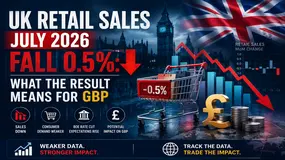
UK retail sales fell 0.5% in July 2026, while the three-month measure rose 1.1%. See the ONS details and what the mixed result may mean for GBP.
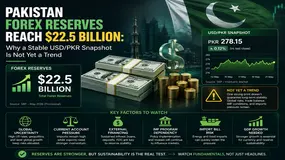
Pakistan forex reserves stood at $22.506 billion on 13 August 2026, while the SBP dashboard showed a USD/PKR mark to market rate of 277.5713 on 20 August. This article separates the SBP forex reserves facts from predictions about the Pakistan rupee and the forex market Pakistan.

A multi-asset liquidity solution can help a broker support FX, CFDs, commodities, and indices through a more unified operating model. But adding asset classes can also create fragmented symbols, pricing, routing, margin rules, records, and client messages if controls are not designed first. This 2026 guide explains how a multi asset liquidity provider, forex CFD liquidity setup, commodity liquidity provider, and indices liquidity provider fit into a broker-owned execution service. It outlines the due-diligence questions, shared-control model, cost drivers, and 90-day implementation plan that help teams expand without making the execution chain harder to explain. The aim is not to promise deeper liquidity or better trading outcomes. It is to create evidence that a broker can supervise market access, trace order events, reconcile costs, and communicate consistently to the relevant clients when conditions are difficult.

Gold surged above $4,500 after the US Treasury expanded its purchases of longer-dated government bonds, pushing yields and the dollar lower. But this was not debt forgiveness or Federal Reserve money printing—it was a liquidity operation that exposed a much bigger fear: America may be finding it increasingly difficult to live with market-driven interest rates.
WikiFXWikiFXWikiFXWikiFXWikiFXWikiFXWikiFXWikiFXWikiFXWikiFX