


UK Retail Sales July 2026 Fall 0.5%: What the Result Means for GBP
UK retail sales fell 0.5% in July 2026, while the three-month measure rose 1.1%. See the ONS details and what the mixed result may mean for GBP.
Original

简体中文
繁體中文
English
Pусский
日本語
ภาษาไทย
Tiếng Việt
Bahasa Indonesia
Español
हिन्दी
Filippiiniläinen
Français
Deutsch
Português
Türkçe
한국어
العربية
اردو

Abstract:June, saw divergent economic outlooks. Initially, the US dollar was under pressure as many believed the Federal Reserve had completed its last rate hike for this cycle. However, this perception changed following the release of robust US economic data and hawkish projections in the FOMC dot-plot.
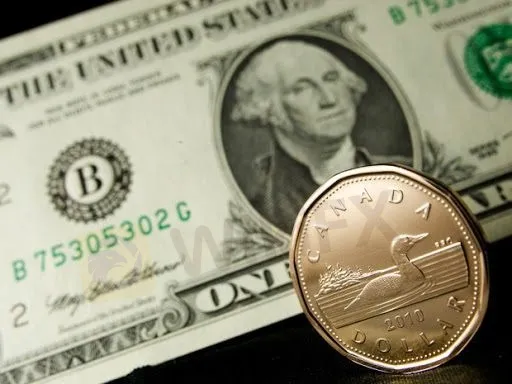
Economic Outlook and Summary
June, saw divergent economic outlooks. Initially, the US dollar was under pressure as many believed the Federal Reserve had completed its last rate hike for this cycle. However, this perception changed following the release of robust US economic data and hawkish projections in the FOMC dot-plot.
Furthermore, Chinas economic rebound from the pandemic has been disappointing, and ongoing tensions with the United States are expected to influence global risk sentiment in July. The latest PMI data from China indicates continued struggles in their economy, and market participants are hopeful that rumors of new stimulus packages being announced will have a positive impact and provide a boost to the global economy.
On July 21, the European Central Bank (ECB) is widely anticipated to announce a 25 basis points rate cut, indicating the potential for further monetary policy adjustments in response to the economic conditions.
The USD and Federal Reserve
The US dollar initially retreated in the first half of June but rallied towards the end of the month. The change in sentiment shifted from expecting rate cuts in the fourth quarter to anticipating two more rate increases, one in the current month and the other in September. This shift in sentiment is influenced by the remarkable resilience of the US economy.
During the first quarter, the economy grew at a rate of 2.0%, which was significantly higher than the expected 1.3% year-on-year growth. Despite inflation showing a decline, the rate of decrease is not considered fast enough for policymakers. As a result, bond traders increased the yield on the US 10-Treasury to 3.86% on July 4, up from a low of 3.60% observed in June.
The Canadian Dollar and Bank of Canada
The Canadian dollar climbed steadily throughout June, powered by the Bank of Canada‘s (BoC) somewhat surprising rate increase on June 7 and the FOMC’s decision to leave US interest rates unchanged. However, this trend is expected to be reversed in July, with the Fed likely to hike rates by 25 basis points (bp) while the BoC keeps rates unchanged.
The Quarterly Business Outlook Survey (BOS), which was released on June 30, showed weakness across the board. The BOS indicator fell from -1.07 in the last quarter to -2.15. (The Bank describes the BOS as “a summary measure of core questions in the BOS.”) This may be sufficient to keep the BoC on the sidelines, unless Canadas employment report (forecasting 20,000 jobs with an unemployment rate of 3.6%) turns out to be significantly stronger than expected.
Meanwhile, the odds for a Fed rate hike on July 22 are at 88.0%, which will support the USDCAD pair, indicating a range of 1.3100-1.3400 for July.
Oil Price
West Texas Intermediate traded choppily in the well-defined $67.00-$74.00/barrel range. Prices reached the peak at the beginning of June when Saudi Arabia announced a unilateral plan to cut oil production by 1.0 million barrels per day. However, prices quickly retreated due to both US recession fears and disappointment from Chinas sluggish economic rebound from Covid-zero policies. The price action was choppy for the rest of the month, with the prospect of higher US interest rates limiting gains.
Saudi Arabia announced an additional 1.0 million barrels per day (m/bpd) production cut beginning in August and was joined by Russia, which promised to cut its production by 500,000 barrels. The cuts should serve to reinforce the $67.00 floor and keep the focus on resistance in the $74.50-$75.00/barrel area.

Disclaimer:
The views in this article only represent the author's personal views, and do not constitute investment advice on this platform. This platform does not guarantee the accuracy, completeness and timeliness of the information in the article, and will not be liable for any loss caused by the use of or reliance on the information in the article.
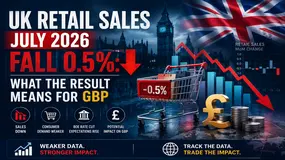
UK retail sales fell 0.5% in July 2026, while the three-month measure rose 1.1%. See the ONS details and what the mixed result may mean for GBP.
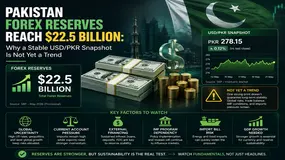
Pakistan forex reserves stood at $22.506 billion on 13 August 2026, while the SBP dashboard showed a USD/PKR mark to market rate of 277.5713 on 20 August. This article separates the SBP forex reserves facts from predictions about the Pakistan rupee and the forex market Pakistan.

A multi-asset liquidity solution can help a broker support FX, CFDs, commodities, and indices through a more unified operating model. But adding asset classes can also create fragmented symbols, pricing, routing, margin rules, records, and client messages if controls are not designed first. This 2026 guide explains how a multi asset liquidity provider, forex CFD liquidity setup, commodity liquidity provider, and indices liquidity provider fit into a broker-owned execution service. It outlines the due-diligence questions, shared-control model, cost drivers, and 90-day implementation plan that help teams expand without making the execution chain harder to explain. The aim is not to promise deeper liquidity or better trading outcomes. It is to create evidence that a broker can supervise market access, trace order events, reconcile costs, and communicate consistently to the relevant clients when conditions are difficult.

Gold surged above $4,500 after the US Treasury expanded its purchases of longer-dated government bonds, pushing yields and the dollar lower. But this was not debt forgiveness or Federal Reserve money printing—it was a liquidity operation that exposed a much bigger fear: America may be finding it increasingly difficult to live with market-driven interest rates.
 WikiFXWikiFXWikiFXWikiFXWikiFXWikiFXWikiFXWikiFXWikiFXWikiFX