


IG Review for India 2026: RBI Alert List, Regulation, Login, and Forex Risk
IG review for India in 2026: see the RBI Alert List entry, overseas regulation, login checks, forex limits, and a clear broker safety checklist.
Original

简体中文
繁體中文
English
Pусский
日本語
ภาษาไทย
Tiếng Việt
Bahasa Indonesia
Español
हिन्दी
Filippiiniläinen
Français
Deutsch
Português
Türkçe
한국어
العربية
اردو




Abstract:In the ever-competitive world of online trading, where margins are slim and timing is everything, traders often obsess over entry strategies, risk management, and technical setups. Yet one critical element is routinely underestimated, if not outright ignored, especially by retail and novice traders alike, is the broker’s spread.

In the ever-competitive world of online trading, where margins are slim and timing is everything, traders often obsess over entry strategies, risk management, and technical setups. Yet one critical element is routinely underestimated, if not outright ignored, especially by retail and novice traders alike, is the brokers spread.
At its core, the spread is the difference between the bid and ask price quoted by a broker. It is, quite simply, the cost of doing business in the markets. For market makers and ECN brokers alike, the spread represents either a primary or supplemental income stream. And for traders, particularly those operating with high frequency or tight profit targets, it represents a potentially significant erosion of earnings.
While a few pips may seem negligible on a single trade, the reality is far from trivial. Consider a scenario where a trader executes 100 trades per month on a major forex pair with an average spread of 1.5 pips, compared to another broker offering 0.5 pips. The difference of 1 pip per trade, when multiplied across all positions, could cost the trader hundreds, even thousands, in cumulative trading costs annually. Over time, such leakage can significantly impact overall profitability, particularly for scalpers, day traders, and algorithmic strategies that rely on high-frequency execution.

Moreover, spreads can vary not only from broker to broker, but also across account types within the same platform. Standard accounts often bundle the cost into wider spreads, while ECN or raw spread accounts may offer tighter pricing but charge a commission. While both pricing models can be legitimate, traders must weigh the total cost per trade, not just the headline spread or commission, to accurately compare accounts.
The importance of a tight, stable spread becomes even more apparent during high-volatility events, such as major economic releases or geopolitical developments. Brokers with subpar liquidity arrangements may widen their spreads dramatically during such periods, triggering stop-outs or undermining strategy effectiveness. As such, consistent spread behaviour under stress conditions is just as critical as the advertised average.
It is also essential to remember that while spreads may appear insignificant in isolation, they compound silently and relentlessly, particularly for traders with narrow profit margins or short-term strategies. In essence, a high spread functions as a form of friction, quietly siphoning off profits that could otherwise have compounded into meaningful gains over time.
In a market where every edge counts, neglecting to evaluate a broker‘s spread offering is not just an oversight, but it is also a strategic error. Savvy traders understand that profitability is not only about making good trades, but also about minimising unnecessary costs. A broker’s spread may not be as attention-grabbing as a trading strategy or signal service, but its long-term impact on performance is arguably just as critical.
Choose your broker wisely. Because in trading, the small things arent so small after all.

Disclaimer:
The views in this article only represent the author's personal views, and do not constitute investment advice on this platform. This platform does not guarantee the accuracy, completeness and timeliness of the information in the article, and will not be liable for any loss caused by the use of or reliance on the information in the article.

IG review for India in 2026: see the RBI Alert List entry, overseas regulation, login checks, forex limits, and a clear broker safety checklist.

Orbex, a Cyprus-based brokerage entity, has recorded 30 exposure complaints on WikiFX, a leading forex broker regulation inquiry tool, so far. Other review websites have also recorded a healthy number of complaints against the brokerage firm. These complaints largely talk about the alleged profit confiscations by the broker in the name of trading violations, difficulty in accessing fund withdrawals, capital losses due to artificial slippage, etc. In this Orbex review, we have investigated user complaints and provided a regulatory overview of the broker.
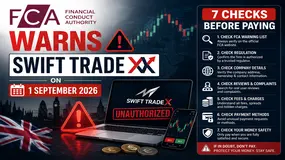
FCA warns Swift TradeX in a notice first published and updated on 1 September 2026. The UK Financial Conduct Authority says the firm may be providing or promoting financial services without permission, is not authorised, and may be targeting people in the UK. The notice names the website swifttradexai.com, a Worcester address and a UK telephone number, but also cautions that unauthorised businesses may use incorrect or borrowed contact details. The confirmed issue is authorisation status—not a court finding about every transaction. Anyone considering a payment should stop, verify the firm independently, and avoid using contact information supplied by the platform itself.

Did mirrox, a brokerage firm, ask you to keep your margin level above 250%-300% and make you add funds immediately if it dropped below it? Did the broker prevent you from opening a trade despite having a healthy equity balance? Did it close your trading account upon a withdrawal request? Many traders have raised these concerns online while sharing their respective mirrox reviews. This article aims to examine these user allegations while answering the popular question: Is mirrox legit or a scam?
WikiFXWikiFXWikiFXWikiFXWikiFXWikiFXWikiFXWikiFXWikiFXWikiFX