Abstract:US President Donald Trump has announced a 50% tariff on copper and copper product imports to the country. He further warned that the import duty on pharmaceuticals can rise up to 200%. Read this to know more details.
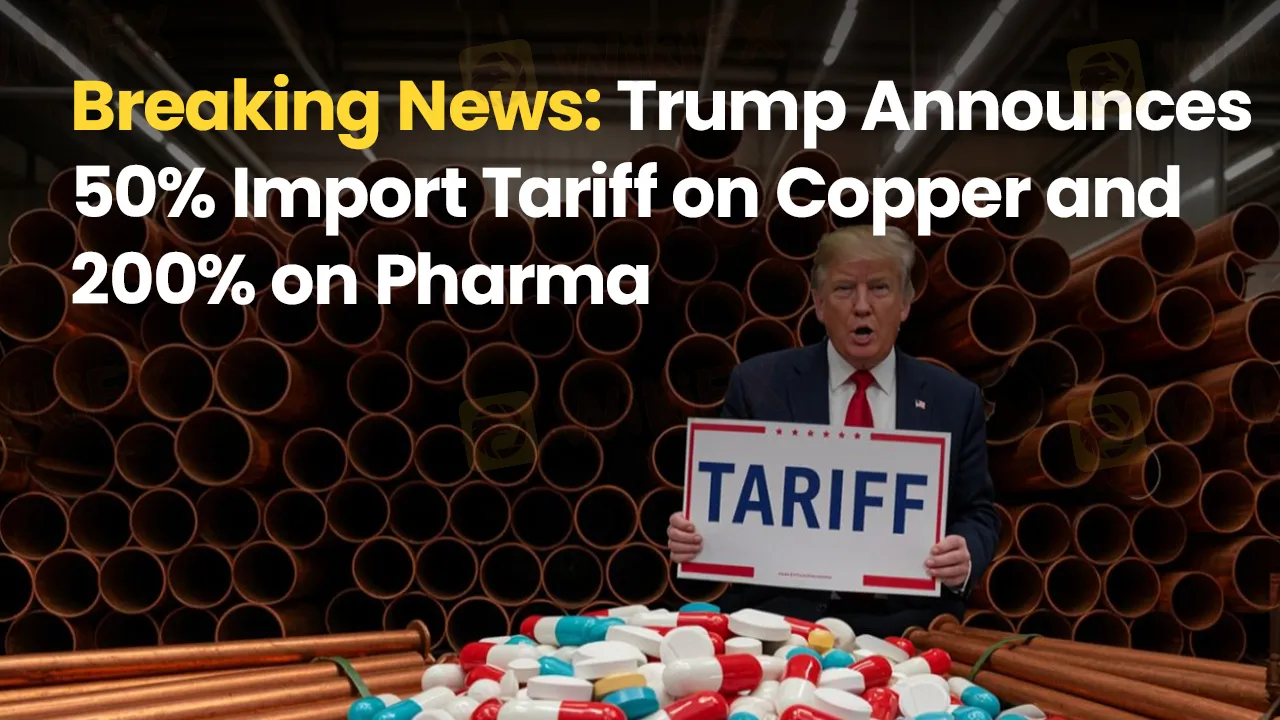
In major news, US President Donald Trump has announced a fresh 50% tariff on copper following the similar duties implemented by his administration on aluminium and steel imports. He further stated that import duties on pharmaceuticals by the US may increase by up to 200% after 2025. Trump made it clear that the deadline for higher US tariffs on various economies worldwide will not extend beyond August 1, 2025. Economies around the world will be impacted by these announcements, especially India, a major copper and pharmaceutical exporter. Lets check out what Trump said and dissect how the announcements will affect India.
Donald Trumps Announcements on Higher Import Tariffs
Donald Trump said while addressing a cabinet meeting on Tuesday, Today we are doing copper. I believe we are going to have a 50% tariff on copper. The levy would expand sector-specific actions the US administration has imposed since assuming office, and has led to a spiral in metal prices.
Commerce Secretary Howard Lutnick said that the US will implement the new rate at the end of July or August 1.
Trump further stated that the US would soon make an announcement on pharmaceuticals. However, officials would give manufacturers the time they need to relocate their operations to the country.
Trump said, the US will give manufacturers about a year or a year and a half to relocate to the US. If they dont do this, they will get tariffed, that too at a very high rate, like 200%.
Trump Orders Probes into Copper, Pharmaceutical Imports in Recent Months
Donald Trump has ordered investigations into imports of copper, semiconductors, pharmaceuticals, critical minerals and lumber, potentially leading to extra levies. Lutnick stated that the US would complete studies on semiconductors and pharmaceuticals by the end of July. Trump will set policies afterward. The US President further reiterated that the White House will impose a 10% tariff on BRICS. He, however, acknowledged that the move is challenging the USD.
How Would Higher Import Tariffs Impact India?
During 2024-25, India shipped copper and copper products worth $2 billion worldwide. Out of which, the total exports to the US were $360 million, accounting for 17% of the overall global export of these products India made during the period. After Saudi Arabia (26%) and China (18%), India exported the maximum copper and copper products to the US, the trade data revealed.
Since copper, being a critical mineral, is widely used across sectors such as infrastructure, manufacturing and energy, any fall in demand across US markets after new tariffs will likely be met by the domestic market.
However, the higher tariff on pharmaceuticals may likely affect India the most. The US remains India‘s largest overseas market for pharma exports. Exports to the US recorded a 21% rise in FY25 from $8.1 billion in FY24. The US accounted for 40% of India’s overall pharma exports worldwide.
Levying 200% on the pharmaceutical sector can lead to a severe demand drop across US markets. Especially as Indias generics industry is critical to affordable medicines in the US.
India, however, is trying to finalize a mini-trade deal with the US, including all sectoral tariffs under it. If both parties are able to finalize a deal before August 1, 2025, the new tariffs may not impact the Indian market.