

Global Broker Regulation Inquiry App
About WikiFX
English
简体中文
繁體中文
English
Pусский
日本語
ภาษาไทย
Tiếng Việt
Bahasa Indonesia
Español
हिन्दी
Filippiiniläinen
Français
Deutsch
Português
Türkçe
한국어
العربية
اردو


Is Malaysia Losing Control of the Online Scam Economy?

WikiFX
|


Abstract:In a parliamentary written reply reported in January 2026, the Home Ministry indicated that Malaysia recorded RM2.77 billion in losses from financial scams in 2025 alone. Over the three year period between 2023 and 2025, total losses linked to online and financial fraud reportedly reached RM5.62 billion.
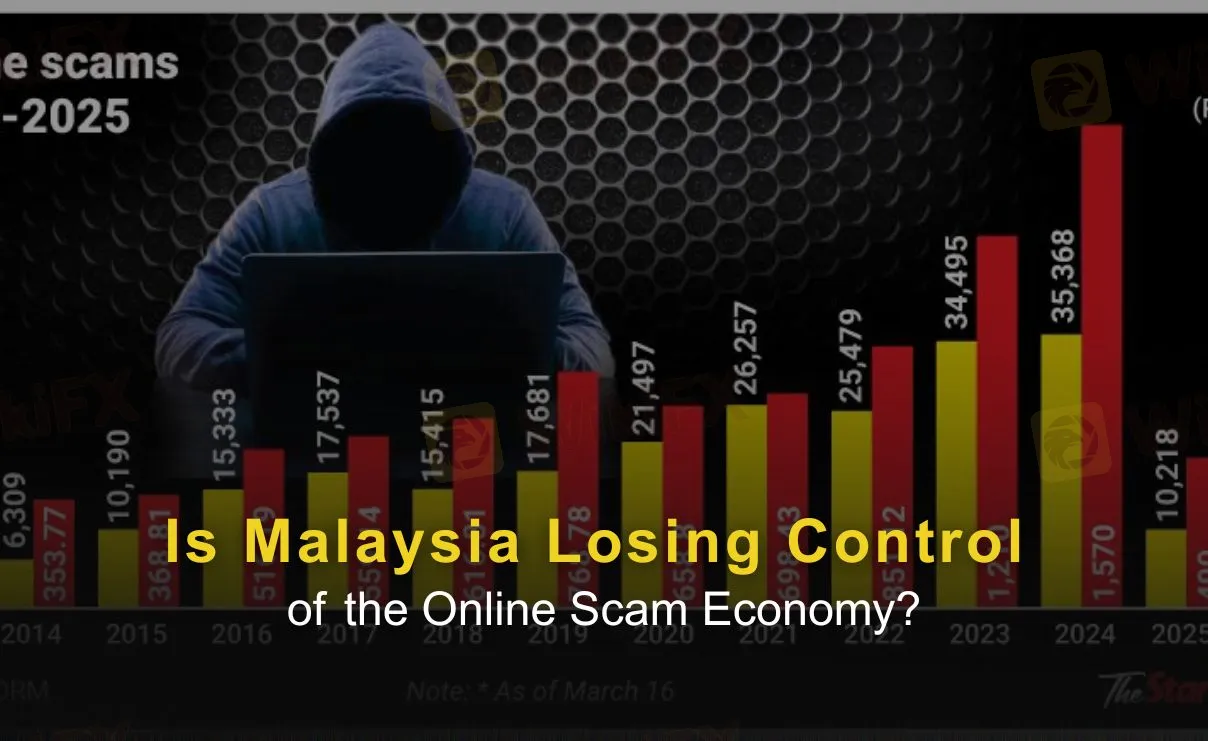
Online scams in Malaysia are increasingly being viewed as more than isolated cases of consumer fraud. What was once framed largely as a problem of individual carelessness is now raising broader concerns about structural weaknesses in the countrys digital ecosystem.
Law enforcement authorities have indicated that roughly 90 per cent of commercial crime cases are now conducted online. Within that category, non existent investment schemes are reportedly among the largest contributors to financial losses. The trend reflects how digital platforms, while enabling economic growth and financial inclusion, may also be creating opportunities for organised scam networks.
The financial impact has grown significant. In a parliamentary written reply reported in January 2026, the Home Ministry indicated that Malaysia recorded RM2.77 billion in losses from financial scams in 2025 alone. Over the three year period between 2023 and 2025, total losses linked to online and financial fraud reportedly reached RM5.62 billion.
Recovery Remains Limited
The problem is compounded by relatively low recovery rates. Parliamentary updates have suggested that only a small portion of scam related losses can be recovered once funds have been transferred through fraudulent channels.
Official figures indicated that RM34 million was recovered in 2025, with RM6.7 million eventually returned to victims. Although enforcement agencies have improved coordination and response mechanisms, recovered funds remain small compared with total reported losses.
This pattern suggests that awareness campaigns alone may not be sufficient. While public education is important, the continued rise in scam losses indicates that structural vulnerabilities within the digital ecosystem could also be enabling fraud. Fraud networks allegedly exploit fast digital payments, online advertising channels and gaps in coordination between institutions.
The Critical First Hour
Speed is often the most important factor in limiting financial damage. Once a victim realises that a fraudulent transfer has taken place, they are usually required to contact several institutions. This process may involve notifying their bank, filing a police report and contacting the National Scam Response Centre.
Malaysia has introduced measures to improve coordination. Bank Negara Malaysia and Payments Network Malaysia launched the National Fraud Portal to speed up scam reporting and help trace stolen funds. Authorities have also discussed protective measures such as account kill switches that allow customers to freeze their accounts if suspicious activity is detected.
Mule Accounts and Fraud Networks
Mule accounts remain a key enabler of scam activity. These are bank accounts allegedly used to receive and transfer illicit funds, often opened by individuals recruited through cash incentives or deception.
Parliament has heard that legal measures were introduced to curb mule account abuse, yet the large gap between total losses and recovered funds indicates that the flow of illicit money remains difficult to contain.
Stronger account opening checks, better transaction monitoring and faster information sharing between financial institutions could help disrupt these networks. Some policymakers have also begun discussing how responsibility for losses should be shared across institutions to strengthen incentives for fraud prevention.
A Broader Digital Economy Challenge
Scams rarely begin with bank transfers alone. Fraudsters often rely on social media advertisements, messaging platforms and spoofed phone calls to approach victims. Authorities have highlighted that non existent investment schemes remain one of the most common forms of fraud, demonstrating how persuasion and digital reach play a central role.
The Ministry of Digital Malaysia has signalled a stronger policy focus on tackling online scams, including initiatives aimed at improving public awareness and strengthening institutional capabilities.
Malaysia has already introduced several tools to combat scams, including the National Fraud Portal and expanded response systems. Yet the scale of reported losses suggests that the challenge remains substantial.

Disclaimer:
The views in this article only represent the author's personal views, and do not constitute investment advice on this platform. This platform does not guarantee the accuracy, completeness and timeliness of the information in the article, and will not be liable for any loss caused by the use of or reliance on the information in the article.
WikiFX Broker
Latest News
New Zealand Dollar: RBNZ seen hiking in September – UOB
WikiFXUSD/JPY Forecast: Retreats from one-month high but dip-buying eyed
WikiFXPolish Zloty: Fiscal slippage and cautious NBP weigh – Commerzbank
WikiFXGermany flash HICP growth remains slower than expected at 2.9% in August
WikiFXJapanese Yen: BoJ normalization expectations and contained moves – BNY
WikiFXEuro strengthens against Canadian Dollar ahead of Germanys HICP data
WikiFXAustralian Dollar holds firm amid hawkish Fed and RBA expectations
WikiFXCanadian Dollar strengthens despite hawkish Fed rhetoric
WikiFXBritish Pound edges higher as USD softens ahead US jobs data
WikiFXUSDCHF: Rising Channel Continuation Toward the Target Zone
WikiFX