Abstract:When checking out a forex broker, traders often deal with lots of mixed information. Moneta Markets is a perfect example of this problem. On one side, it shows itself as a well-established, regulated broker with good trading conditions that bring in thousands of clients. On the other side, the internet is full of serious scam allegations, especially about holding back people's capital. This creates an important question for any future trader: is Moneta Markets a legitimate partner or a clever trap?
This investigation wants to cut through all the confusion. We will not give you a simple "yes" or "no" answer. Instead, we will do a balanced and fact-based analysis to help you make a smart decision. We will break down the clear signs of its legitimacy, look closely at the specific details of negative complaints, and compare this conflicting evidence. Our analysis is based on facts you can check, including the broker's official regulatory status, real-world operational checks, and a deep l
When checking out a forex broker, traders often deal with lots of mixed information. Moneta Markets is a perfect example of this problem. On one side, it shows itself as a well-established, regulated broker with good trading conditions that bring in thousands of clients. On the other side, the internet is full of serious scam allegations, especially about holding back people's capital. This creates an important question for any future trader: is Moneta Markets a legitimate partner or a clever trap?
This investigation wants to cut through all the confusion. We will not give you a simple “yes” or “no” answer. Instead, we will do a balanced and fact-based analysis to help you make a smart decision. We will break down the clear signs of its legitimacy, look closely at the specific details of negative complaints, and compare this conflicting evidence. Our analysis is based on facts you can check, including the broker's official regulatory status, real-world operational checks, and a deep look into user-reported experiences. By the end of this article, you will have a clear way to judge the true nature of Moneta Markets and the risks involved.
The Case for Legitimacy
To understand the full picture, we must first look at the evidence that supports Moneta Markets' claim as a legitimate brokerage. These are the “green flags” that attract traders and suggest a stable, working business. They are real, checkable, and form the foundation of the broker's credibility.
Strong Regulatory Oversight
The single most important foundation of a broker's legitimacy is its regulatory status. Moneta Markets holds licenses in multiple locations, but its most important is regulation by the UK's Financial Conduct Authority (FCA). This is considered a top-level regulatory body, known for its strict requirements and investor protection measures.
FCA regulation is not just a piece of paper; it creates strict operational rules:
· Client Fund Segregation: The broker is legally required to hold client funds in accounts that are completely separate from its own company funds. This prevents the misuse of trader capital for business expenses.
· Financial Services Compensation Scheme (FSCS): This is an important safety net. Should the FCA-regulated part of Moneta Markets become bankrupt, eligible clients are protected for up to £85,000. This is a powerful signal of security that unregulated or offshore brokers cannot offer.
In addition to the FCA, the broker is also regulated by South Africa's FSCA, providing another layer of oversight. Operating under these frameworks shows that Moneta Markets is subject to legal and financial scrutiny in reputable locations.
Operating History
Quick scams rarely last long. Moneta Markets has an operating history of 5-10 years, showing it is not a new or temporary operation. It has kept its business running through various market cycles, which gives it some credibility.
Furthermore, independent verification adds another layer of trust. According to data from WikiFX, their teams have conducted field surveys that successfully verified the existence of physical office locations for Moneta Markets in the UK, Thailand and Dubai. This real-world verification directly counters the fear of dealing with a “ghost” company that exists only online. A checkable physical presence confirms a real-world business.
Competitive Trading Conditions
A broker's legitimacy is also supported by the quality of its service offerings. Many positive user reviews highlight Moneta Markets' competitive trading environment, which is a main reason traders consider the platform. The key features that stand out include:
· Diverse Instruments: Access to over 1000+ tradable assets, including Forex, Indices, Commodities, and an extensive list of Share CFDs.
· Advanced Platforms: Support for the industry-standard MT4 and MT5 platforms, alongside its own PRO Trader platform which works directly with TradingView charts.
· Competitive Costs: Spreads on its PRIME ECN account start from 0.0 pips, with a commission of $3 per lot per side, which is attractive for scalpers and high-frequency traders.
· High Leverage: The ability to access leverage up to 1000:1. While this increases profit potential, it must be noted that it equally increases the risk of loss and should be used with extreme caution.
· Low Entry Barrier: The minimum deposit is just $50 for STP and Prime ECN, making the platform accessible for beginners and those wanting to test the service with minimal money.
Analyzing the Red Flags
Despite the strong case for legitimacy, it is impossible to ignore the large volume of serious complaints filed against Moneta Markets. The WikiFX platform, for instance, clearly notes that the broker's score is reduced because of “too many complaints.” These are not minor complaints about slippage or customer service wait times; they are consistent allegations that hurt the broker's trustworthiness.
A Pattern of Complaints
When analyzing user exposure reports, several alarming patterns emerge. These are not isolated incidents but recurring themes reported by different traders across various regions, suggesting systematic issues.
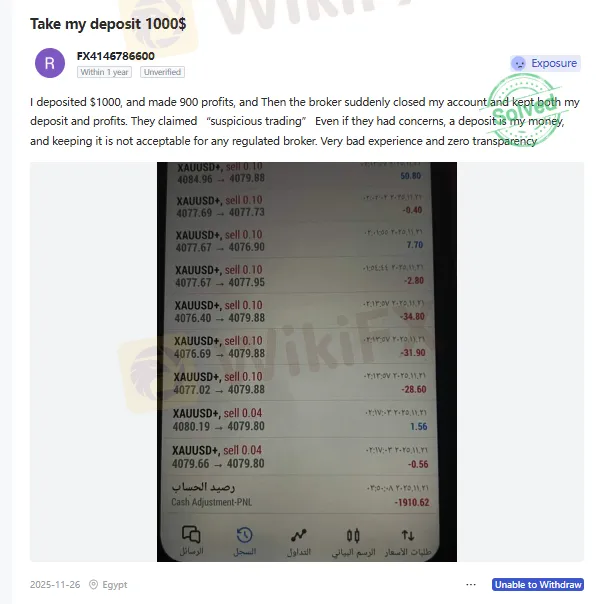
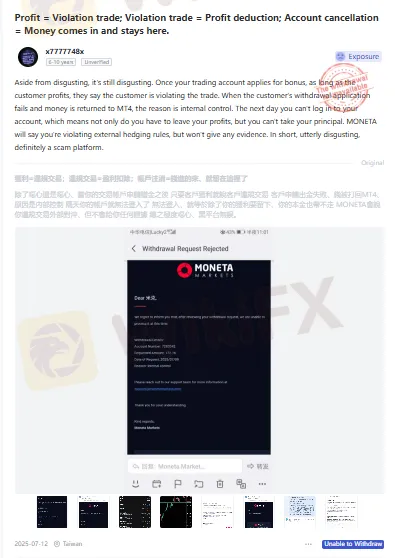
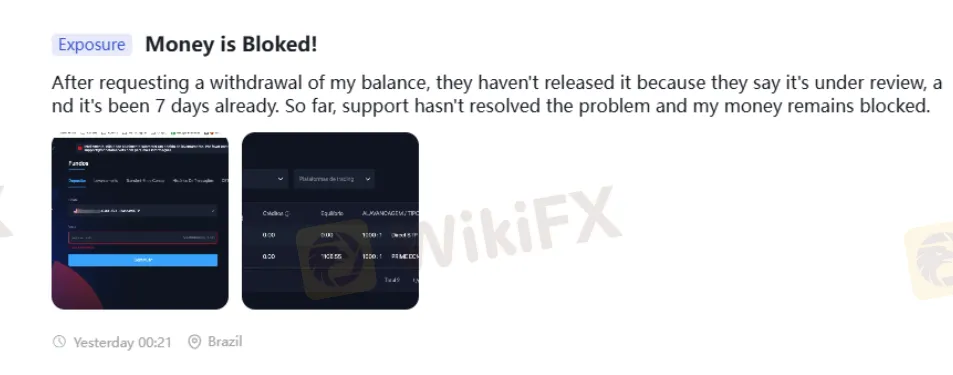
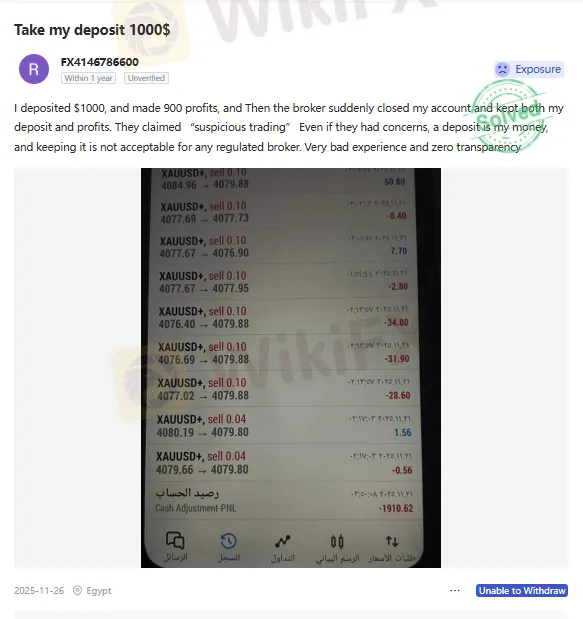
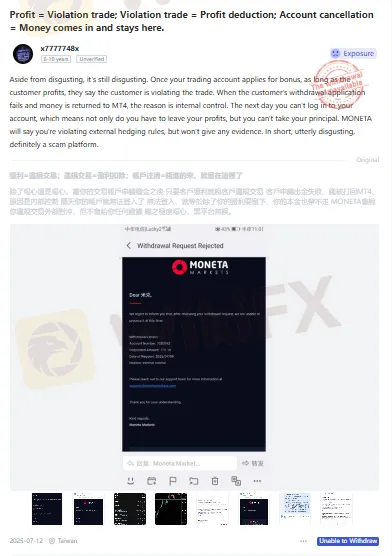
· Withholding Funds: The most severe and frequent allegation is the refusal to process withdrawals. This applies not only to profits but, in some cases, to the trader's principal deposit as well. This often happens after a period of successful trading.
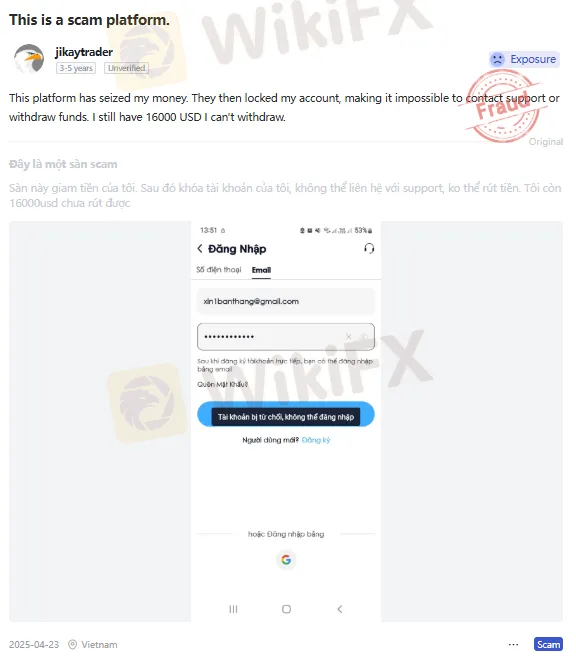
· Sudden Account Closure: Many traders report their accounts being suddenly locked or closed without warning. The broker then allegedly stops all communication, leaving the trader with no way to get help.
· Questionable Justifications: When a reason is given for taking funds, it is often a vague and unverifiable claim. Terms, such as “suspicious trading” or “violating external hedging rules”, are used without providing concrete evidence of the alleged wrongdoing. This makes it difficult for traders to challenge the decision.
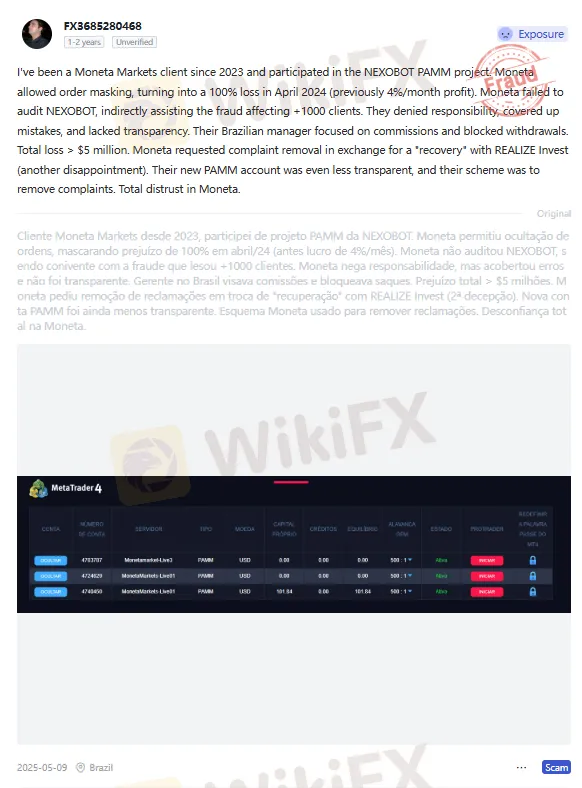
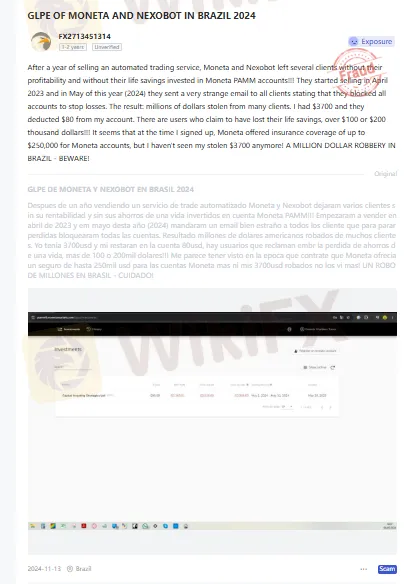
· Third-Party Service Failures: Significant issues have come from services associated with the broker, particularly PAMM accounts. In these cases, Moneta Markets is accused of being involved or failing to protect investors when the third-party manager causes massive losses.
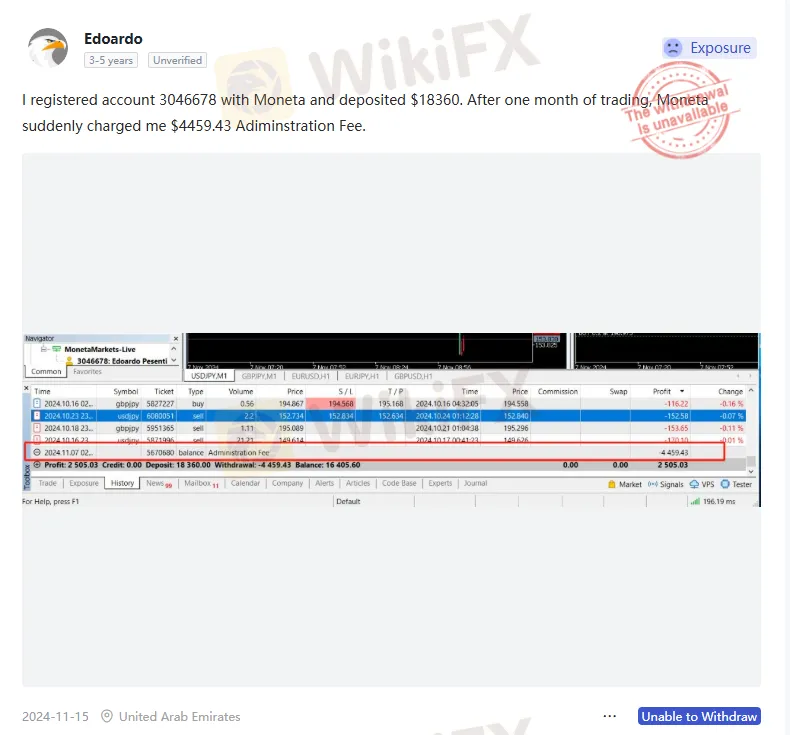
· Unexpected Fees: There are reports of large, unexplained fees being taken from accounts. One user cited a sudden “$4,459.43 Administration Fee” charged without prior justification.
Case Study: Nexobot PAMM
To understand the seriousness of these complaints, let's look at a specific, well-documented case: the collapse of the Nexobot PAMM service in Brazil, which affected many Moneta Markets clients in 2024 and 2025. A Percentage Allocation Management Module (PAMM) account is a form of managed account where investors pool their funds to be traded by a single manager.
The allegations in this case are detailed and severe:
1. Hiding Losses: The PAMM manager, Nexobot, allegedly disabled the display of open trades on the Moneta Markets platform. This critical feature, known as the “Floating Balance,” was hidden, preventing investors from seeing the huge, growing losses in real-time.
2. Blocking Withdrawals: As the situation got worse, investors who tried to withdraw their funds were allegedly blocked by both the PAMM manager and the broker. Requests were ignored or outright refused.
3. Broker Responsibility: Moneta Markets is accused of being partly responsible for the disaster. Critics argue the broker failed in its due diligence by not properly checking the PAMM manager and, more critically, by allowing its platform to be set up in a way that hid essential risk information from investors.
This case study turns abstract complaints into a concrete example of the potential risks. It highlights a failure in oversight and risk management that resulted in substantial financial losses for clients.
Offshore Entity Risks
This is an important detail that many traders overlook. While Moneta Markets proudly advertises its FCA regulation, the traders actual protection depends entirely on which legal entity their account is registered with.
Expert analysis of WikiFX data reveals that while a UK entity exists, many of the broker's servers are located in Mauritius and company entities are registered in South Africa. Often, traders from outside the UK are signed up through these offshore entities. An account registered under an offshore entity does not benefit from the same protections as a UK-based account, most notably the FSCS compensation scheme. This “regulatory arbitrage” is a common practice, but it means that in a dispute, your legal options may be far weaker than you believe.
The Verdict
So, how do we make sense of these two very different portrayals? Is MONETA MARKETS Legit or not? The evidence suggests the answer is not a simple YES or NO. The broker appears to show a dual personality, behaving differently under different circumstances.
Not a Scam, But High-Risk
Based on its long operational history, physical presence, and top-tier FCA regulation, it would be wrong to label Moneta Markets as an outright fake or MONETA MARKETS Scam. It is a real, functioning company that provides legitimate trading services to many clients, which explains the numerous positive reviews.
However, it is more accurately described as a high-risk partner. This “dual personality” can be broken down as follows:
1. For Standard Traders: For many retail traders who deposit small amounts, trade conventionally, and generate modest profits, Moneta Markets likely functions as a perfectly legitimate broker with competitive conditions.
2. For “Problematic” Traders: The risk profile appears to change dramatically for traders who are highly profitable, use certain Expert Advisors (EAs), rely on bonus promotions, or invest in associated third-party services such as PAMMs. In these scenarios, the broker has been accused of acting opportunistically, using unclear terms in its client agreement to justify fund withholding.
This framework helps explain why user experiences are so different. The primary risk is not that the broker is fake, but that it may prove to be an unreliable partner precisely when you are most successful.
Regulation vs Reality
It's important to understand that regulation is a safety net, not a guarantee of a perfect experience. Disputes between traders and regulated brokers happen. However, the volume, consistency and severity of the complaints against Moneta Markets, particularly concerning the fundamental issue of fund withdrawals, are a serious concern that regulation alone does not erase.
The existence of an FCA license is a major point in its favor, but the pattern of behavior reported by a significant number of users suggests a high-risk environment. The key is to acknowledge this risk before committing investments.
A Safety-First Action Plan
If you are still considering trading with Moneta Markets despite the risks, it is essential to proceed with a disciplined, safety-first approach. The following checklist is designed to help you verify the broker's processes and minimize your potential exposure. Treat these steps as a non-negotiable protocol.
Before You Deposit
1. Confirm Your Regulatory Entity: This is the most critical step. During the account opening process, find out and get written confirmation of the legal entity your account is registered under. If it is not a UK FCA-regulated entity, you will not have FSCS protection.
2. Start Small: Do not make a large initial investment. Deposit only the minimum required amount ($50) or a similarly small sum you are fully prepared to lose.
3. Test the Withdrawal Process: This is the ultimate legitimacy test. After placing a few small trades (win or lose), immediately attempt to withdraw a portion of your funds, or even the entire initial deposit. A smooth, fast and hassle-free withdrawal is the single most important green flag. If you encounter delays, excuses or problems, consider it a major red flag.
4. Carefully Read the Terms & Conditions: Read the client agreement carefully. Pay special attention to clauses related to bonuses, “abnormal trading,” “arbitrage,” and “hedging.” These are the terms often used by brokers, such as MONETA MARKETS, to justify the cancellation of profits or closure of accounts.
5. Avoid Third-Party PAMMs: Given the documented issues with the Nexobot case, be extremely careful about investing in any PAMM or copy trading service promoted by or linked to the broker. The risk of inadequate oversight appears to be high.
If You Trade
· Keep Detailed Records: Document everything. Take screenshots of your account dashboard showing your balance, your complete trade history, all deposit and withdrawal requests, and save all email and live chat communications with customer support. This documentation is invaluable if a dispute arises.
· Understand the Dispute Process: Know your rights. If you are an FCA client, familiarize yourself with how to file a complaint with the UK's Financial Ombudsman Service. If you are under an offshore entity, understand its (often limited) dispute resolution process.
Final Conclusion
Our investigation concludes that Moneta Markets is a regulated, operational broker, not a simple fake. It has a legitimate corporate structure, top-tier regulation in the UK, and provides competitive trading conditions that satisfy many of its clients.
However, this “legitimate” status must be viewed with serious warnings. The high potential risk warning issued by platforms like WikiFX is not without merit. The consistent and severe pattern of complaints regarding fund withdrawals and account closures is too substantial to be ignored. Moneta Markets operates as a broker with a dual personality: a reliable partner for some, but a high-risk proposition for others, particularly successful traders.
Ultimately, the choice is yours. The decision to trade with Moneta Markets depends entirely on your personal risk tolerance and whether you are willing to carefully follow the safety checklist provided.
For more extensive broker review like this, download the new WikiFX app by scanning this QR code.