


IG Review for India 2026: RBI Alert List, Regulation, Login, and Forex Risk
IG review for India in 2026: see the RBI Alert List entry, overseas regulation, login checks, forex limits, and a clear broker safety checklist.
Original

简体中文
繁體中文
English
Pусский
日本語
ภาษาไทย
Tiếng Việt
Bahasa Indonesia
Español
हिन्दी
Filippiiniläinen
Français
Deutsch
Português
Türkçe
한국어
العربية
اردو




Abstract:Foreign exchange trading is basically of two types: Direct Market Access (DMA) and Over the Counter (OTC). Both come with their own pros and cons. It’s important to understand these two concepts before figuring out the differences between them. In this article, we will explain all of these.
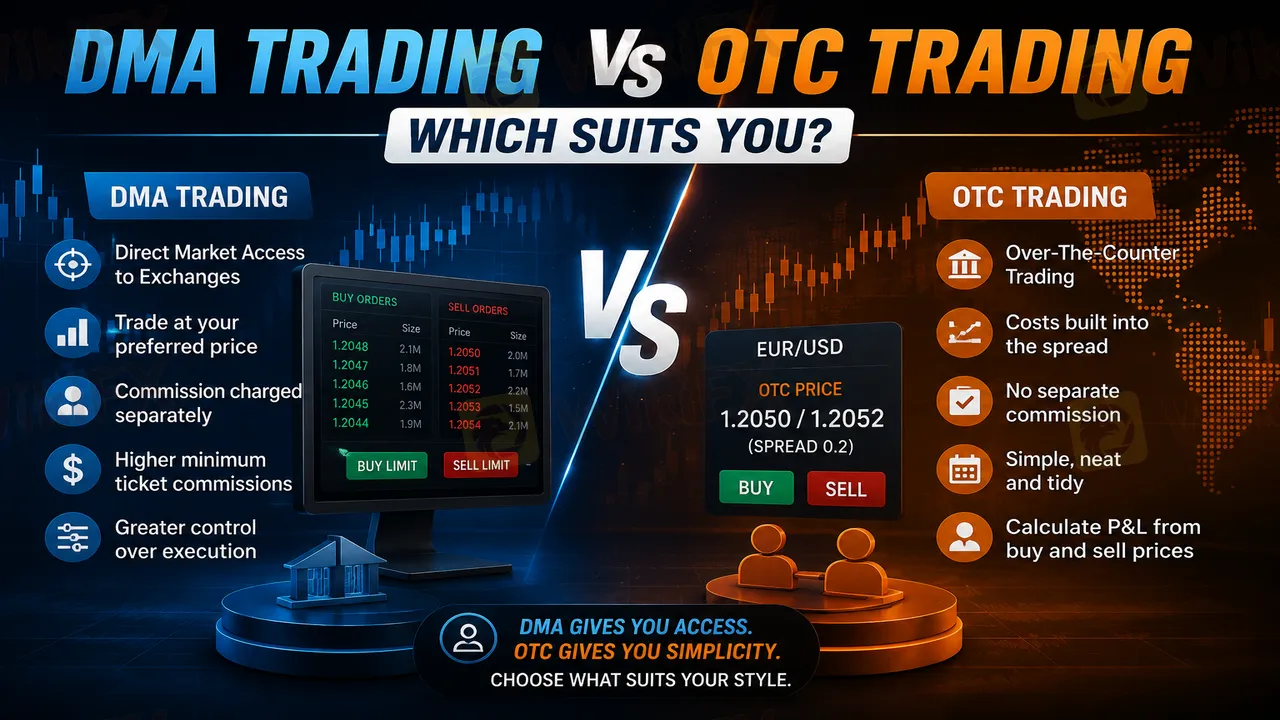
Foreign exchange trading is basically of two types: Direct Market Access (DMA) and Over-the-Counter (OTC). Both come with their own pros and cons. Its important to understand these two concepts before figuring out the differences between them. In this article, we will explain all of these.
 Contents
DMA trading is a tool to deal in on-exchange contracts. This tool lets you trade prices set by several brokers and market makers, who feed their orders into a central exchange. This remains suitable for users with high-frequency trades. This set of users are usually professional or institutional traders, as well as scalpers.
OTC trading platforms are a tool where users trade against the brokers price. Brokers can sometimes hedge a trade in the underlying market. However, the b-book usually manages the retail order flow. Retail traders with not much in need of liquidity for smaller orders will likely choose this trading tool.
Retail traders who want to upgrade from a CFD or spread betting broker to a DMA trading platform should be aware of the differences between DMA and OTC trading.
Using a spread betting broker for trading comes with the obvious tax benefit. Yes, there are no taxes. Since these trades are structured as an amount per point move bet, they do not come under the purview of capital gains tax. As a profitable trader acting on your own, you need to assess which is more important - whether or not paying taxes on profits or direct market access. DMA trading is not available through spread betting. For this, you need a CFD broker.
DMA trading lets you have direct market access to the underlying exchange. For example, if you trade a stock on the exchange: DMA:644.5/644.8 versus CFDs/spread betting: 644.5/646. However, with the DMA, the price becomes better as you can easily put your buy or sell orders within the spread to make it tighter. So, if you want to purchase at 644.6 instead of the offered price (644.8) and there are no sellers, you wont get filled. However, the scope for better pricing is enhanced.
One of the key advantages of OTC CFDs and spread betting is simplicity: most trading costs are built into the spread. You see the price, place the trade, and calculate your profit or loss from the buy and sell prices—without having to separately account for commission or administration.
DMA works differently. With direct market access, your orders are sent directly to the exchange through your broker. Instead of buying at the offer or selling at the bid, you can place a limit order at the bid and sell at the offer. Youre filled at your chosen price when another market participant is willing to trade against your order.
The trade-off is that DMA brokers charge commission separately, usually when you open and close a position. They may also impose minimum commissions per trade, which can make DMA less attractive for smaller traders. For example, if the round-trip minimum commission is around £10, a scalper needs to capture enough points to cover that cost before making a profit.
With OTC spread betting or CFDs, the broker effectively builds its costs into the quoted spread. With DMA, you get more direct control over your entry and exit prices, but you have to factor commission into every trade.
Ultimately, it comes down to preference. OTC CFDs and spread betting are neat and straightforward; DMA offers greater control over execution but comes with additional commission and cost considerations.
Download the WikiFX app for the latest forex updates.

Knowledge pays at WikiFX.Every time you share a WikiFX article, you'll receive 50 Reward Points. Grow your rewards with every share and unlock exclusive gifts in the WikiFX Points Mall. Start earning today!

Disclaimer:
The views in this article only represent the author's personal views, and do not constitute investment advice on this platform. This platform does not guarantee the accuracy, completeness and timeliness of the information in the article, and will not be liable for any loss caused by the use of or reliance on the information in the article.
IG review for India in 2026: see the RBI Alert List entry, overseas regulation, login checks, forex limits, and a clear broker safety checklist.

Orbex, a Cyprus-based brokerage entity, has recorded 30 exposure complaints on WikiFX, a leading forex broker regulation inquiry tool, so far. Other review websites have also recorded a healthy number of complaints against the brokerage firm. These complaints largely talk about the alleged profit confiscations by the broker in the name of trading violations, difficulty in accessing fund withdrawals, capital losses due to artificial slippage, etc. In this Orbex review, we have investigated user complaints and provided a regulatory overview of the broker.
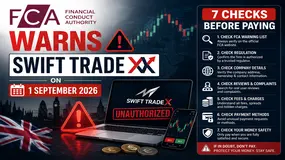
FCA warns Swift TradeX in a notice first published and updated on 1 September 2026. The UK Financial Conduct Authority says the firm may be providing or promoting financial services without permission, is not authorised, and may be targeting people in the UK. The notice names the website swifttradexai.com, a Worcester address and a UK telephone number, but also cautions that unauthorised businesses may use incorrect or borrowed contact details. The confirmed issue is authorisation status—not a court finding about every transaction. Anyone considering a payment should stop, verify the firm independently, and avoid using contact information supplied by the platform itself.
ThinkMarkets review for India: check the RBI Alert List, overseas entities, regulation, login security, forex rules, costs, withdrawals, and leverage risk.
WikiFXWikiFXWikiFXWikiFXWikiFXWikiFXWikiFXWikiFXWikiFXWikiFX