


India Q1 FY27 GDP Growth Hits 7.8%: 3 Scenarios for INR and Gold
India's Q1 FY27 GDP grew 7.8%, beating a 7.4% poll and RBI's 7.0% projection. See three conditional scenarios for INR, rates and gold.
Original

简体中文
繁體中文
English
Pусский
日本語
ภาษาไทย
Tiếng Việt
Bahasa Indonesia
Español
हिन्दी
Filippiiniläinen
Français
Deutsch
Português
Türkçe
한국어
العربية
اردو




Abstract:In forex trading, a pip is the smallest unit of price movement between two currencies. It’s used to measure changes in exchange rates, calculate profits or losses, and manage trading strategies effectively.
 Contents
In the world of forex trading, few terms are as frequently used yet misunderstood as the pip. Every time a trader discusses a currency pair‘s movement, calculates profit or loss, or sets up a stop-loss, they’re dealing in pips — whether they realize it or not.
Understanding “pips meaning forex” is fundamental for anyone entering the market. Pips are the universal measurement of price change in currency trading, much like inches are to distance or degrees to temperature. Without a solid grasp of pips, a trader cant accurately gauge performance, manage risk, or make informed decisions.
So, what exactly is a pip, how is it calculated, and why does it matter so much? Lets break it down step-by-step.
A pip, short for “percentage in point” or “price interest point,” is the smallest standardized unit that measures the change in value between two currencies.
In most currency pairs, one pip equals a movement of 0.0001 in price. For example, if EUR/USD moves from 1.1050 to 1.1051, thats a 1-pip increase.
The concept of pips originated to maintain consistency in quoting exchange rates. Before electronic trading and fractional pricing, pips represented the smallest movement most brokers would display. The standardization made it easy to communicate and compare price movements universally across brokers and traders.
Because currencies are often traded in enormous volumes, even small pip fluctuations can represent significant profit or loss — particularly when leverage is applied.
The calculation of pips depends on the currency pair and its decimal placement.
For currency pairs like EUR/USD or GBP/USD, one pip = 0.0001.
Example:
If EUR/USD moves from 1.1000 to 1.1005, thats a 5-pip movement.
For pairs involving the Japanese yen, such as USD/JPY, one pip = 0.01.
Example:
If USD/JPY moves from 145.25 to 145.40, thats a 15-pip change.
These can vary depending on the number of decimal places your broker quotes. Always verify before trading.
Major pairs like EUR/USD and GBP/USD usually have tighter spreads and more liquidity, while minor and exotic pairs might show larger pip movements due to lower liquidity and higher volatility.
In trading jargon, people sometimes confuse pips, points, and ticks. Although they all measure price movement, their meanings differ depending on the market.
Example Comparison:
If EUR/USD moves from 1.1050 to 1.1051, thats 1 pip or 10 points in some trading platforms.
Understanding these distinctions prevents confusion when reading charts, analyzing reports, or using algorithmic systems that may refer to points instead of pips.

Pips directly determine how much a trader earns or loses from a trade.
Example Scenario:
Suppose you buy 1 standard lot (100,000 units) of EUR/USD at 1.1000 and close the trade at 1.1020. Thats a 20-pip increase.
If each pip on a standard lot of EUR/USD equals $10, your profit is:
[
20 \text{ pips} \times $10 = $200
]
Conversely, if the market moves 20 pips against you, that equals a $200 loss.
Thus, knowing how pip values translate into actual money helps traders measure potential outcomes and manage their emotional reactions to market changes.
Modern trading platforms often display prices with five decimal places (or three for JPY pairs). The extra digit represents a pipette, which is one-tenth of a pip (0.00001 for most pairs).
Example:
A move from 1.10500 to 1.10510 equals 1 pipette or one-tenth of a pip.
Brokers introduced pipettes to offer more precise pricing and tighter spreads. This granularity benefits high-frequency and scalping traders who rely on minute movements to capture profits.
Lot size plays a critical role in determining the monetary value of each pip. There are three common lot sizes in retail forex:
Using EUR/USD again, where one pip is 0.0001:
| Lot Size | Pip Value (approximate) |
| Standard lot | $10 per pip |
| Mini lot | $1 per pip |
| Micro lot | $0.10 per pip |
Thus, trading a micro lot reduces risk exposure, which is especially useful for beginners learning risk management.
Calculating pip value allows traders to precisely determine potential profits or losses across any currency pair.
Step-by-Step Process:
Example 1 – USD as Quote Currency (EUR/USD):
You trade one standard lot (100,000 units).
[
\text{Pip Value} = 0.0001 \times 100{,}000 = $10
]
Example 2 – Non-USD Quote Currency (GBP/JPY):
The pair quotes at 185.50.
[
\text{Pip Value (JPY)} = 0.01 \times 100{,}000 / 185.50 \approx 538.94 , \text{JPY per pip}
]
Converted to USD (assuming 1 USD = 150 JPY):
[
538.94 / 150 = $3.59 \text{ per pip}
]
This process shows how pip value fluctuates based on both pair pricing and your account currency.
Effective traders never risk money without knowing how much each pip is worth. Before entering a position, you should calculate the potential loss if your stop-loss order is triggered.
Example:
If you risk 2% of a $10,000 account per trade (i.e., $200 maximum), and each pip is worth $10, your stop-loss should be no more than 20 pips away.
Pips are also essential for the following:
Ignoring pip value can quickly lead to over-leveraging — a leading cause of losses among new forex traders.
Every time you trade a currency pair, youll notice a small difference between the bid (sell) and ask (buy) prices. This difference is called the spread, typically measured in pips.
Example:
If EUR/USD quotes at 1.1000 / 1.1002, the spread is 2 pips.
The spread is essentially the brokers fee for executing your trade. Tight spreads mean lower trading costs, which is crucial for scalpers or high-frequency traders who rely on small, rapid movements.
Be aware that during periods of high volatility or low liquidity, spreads may widen, increasing transaction costs.
Even experienced traders make pip-related errors that can undermine performance.
Common pitfalls include:
Always double-check pip calculations before placing a trade, especially in exotic pairs with unusual conversion rates.
Beyond basic measurement, pips serve as a building block for advanced forex strategies:
In other words, mastering pip analysis gives you a more nuanced understanding of price behavior and risk.
Understanding pips' meaning in forex isn‘t just an academic exercise — it’s a core skill that separates informed traders from gamblers. Pips quantify exactly how much a market moves, how much you gain or lose, and how much risk you can afford.
Once you can easily calculate pip value, setting stop-losses, taking profits, and scaling positions becomes second nature.
Start by practicing pip calculations in a demo trading account before applying them in live conditions. With consistent attention to pip value and risk control, youll trade with precision, confidence, and professional-level discipline — the hallmarks of successful forex trading.

Disclaimer:
The views in this article only represent the author's personal views, and do not constitute investment advice on this platform. This platform does not guarantee the accuracy, completeness and timeliness of the information in the article, and will not be liable for any loss caused by the use of or reliance on the information in the article.
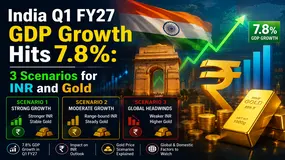
India's Q1 FY27 GDP grew 7.8%, beating a 7.4% poll and RBI's 7.0% projection. See three conditional scenarios for INR, rates and gold.
Choosing a forex liquidity provider is not a search for the lowest displayed spread or the longest provider list. It is a broker decision about pricing integrity, depth, routing, credit, reporting, incident response, and client communication. This 2026 guide explains how a forex LP, FX liquidity provider, or liquidity provider forex arrangement fits into a broker’s execution chain; what to test before onboarding; why a “best forex liquidity provider” claim cannot replace due diligence; and how to compare cost beyond commission. Use the execution-quality scorecard, provider questions, routing scenarios, and 90-day onboarding plan to assess whether a liquidity relationship can support your actual client mix, instruments, risk model, and jurisdiction. The goal is not to make a universal ranking. It is to build evidence that your broker can explain, supervise, reconcile, and recover its execution service when market conditions are difficult.
The visible fee in an MT4 white label proposal is rarely the real cost of operating it. For an existing broker, the decision is not simply whether an MT4 white label platform is “cheap” or “expensive.” The real question is whether the commercial model remains viable after integration, support, data, client migration, compliance, and exit costs are included. That is why an MT4 white label cost review should be built as a 24- to 36-month operating case. It should compare three credible choices: 1. Keep the present MT4 setup and improve its weakest controls. 2. Replace the MT4 white label provider but retain the client proposition. 3. Migrate selected clients or products to another platform while running MT4 in parallel. This guide explains how to build that case without relying on headline prices or generic vendor claims.
Withdrawal delays are precisely the complaint we keep receiving on WikIFX, a veteran in the forex regulation inquiry space. While some users receive withdrawal access initially and find rejections on their applications later, some fail to receive a single approval. Some delays usually result from genuine compliance requirements that brokers need to adhere to. However, in many cases, traders have accused the broker of repeated excuses as part of its alleged strategy to deny a seamless fund release. A pending withdrawal cannot be an outright indicator of fraudulent activity. Financial institutions, including forex brokerage entities, need to abide by the anti-money laundering (AML) and Know Your Customer (KYC) regulations. However, as the monitoring process stretches beyond weeks or months, traders become frustrated and raise questions over the broker’s reliability.
WikiFXWikiFXWikiFXWikiFXWikiFXWikiFXWikiFXWikiFXWikiFXWikiFX