

Global Broker Regulation Inquiry App
About WikiFX
English
简体中文
繁體中文
English
Pусский
日本語
ภาษาไทย
Tiếng Việt
Bahasa Indonesia
Español
हिन्दी
Filippiiniläinen
Français
Deutsch
Português
Türkçe
한국어
العربية
اردو


Forex trading psychology: why old prices stick in your mind

WikiFX
|


Abstract:Anchoring bias is the tendency to treat an old forex price as the fair reference even after conditions change. This beginner guide explains the psychology with a hypothetical EUR/USD example and gives a simple four-step observation exercise.

Have you ever looked at a chart and felt that a currency price is cheap just because it used to be higher? That feeling has a name: anchoring bias. Anchoring bias is the mental habit of leaning too heavily on the first number you meet, often a historical price, when you judge a new situation. It is normal, and almost every forex beginner meets it early in their learning.
Forex, or foreign exchange, is the market where one currency is traded against another. A currency pair, such as EUR/USD or GBP/USD, shows how much of one currency you need to buy one unit of the other. The pair's number only has meaning relative to other moments, so your brain faces an extra trap: it treats a remembered number as if it were a fact.
 Contents
Why a remembered price feels like a reference point
Think of a shop sign that says 'Was 200, now 150.' The old price makes 150 feel like a bargain, even if 150 is still too expensive for the item. The same mental shortcut happens in forex. The quote, or current displayed price, on your screen is a relative number, not an absolute value, so 'cheap' is always a comparison, never a property of the price itself.
Hypothetical teaching example, not real trading advice: suppose EUR/USD spent several weeks near 1.1800 and later moves to 1.1593. A beginner might think, 'It has dropped a lot, so it deserves to recover.' But 1.1800 is just a memory unless a large group of active market participants is also treating that level as important. If economic conditions have changed, 1.1593 can be too expensive rather than too cheap. The old level did the thinking for you, and that is exactly when anchors become dangerous.
This example is for education only. It is not a suggestion about what EUR/USD will do next, and it is not a recommendation to buy or sell anything.
Where anchors hide in your observations
- Your own entry price, the price at which you opened a position, meaning a trade that is now active: once you have that price, it becomes the number you compare everything against. That can make a current price feel 'good' or 'bad' mainly because of your own history.
- A recent high or low: a swing high or swing low is a price level where the market previously turned. It sticks in memory and later turns a completely different price into 'cheap' or 'expensive'.
- Round numbers: levels such as 1.1500 or 100.00 feel like natural magnets even though markets do not give them special power by themselves.
- A headline price: a quote you saw while a big news story broke becomes tied to the story. Seeing the price later can replay the same emotion you felt at the news moment.
None of these anchors are useless by themselves. They only become misleading when you mistake the memory for current evidence.
A small observation exercise
Instead of trying to erase the anchor, learn to notice it. You can do this in a notebook, on a chart, or in a practice account, which is a simulated account where you trade with virtual money to build skill. The goal is not to decide what to buy or sell; it is to see how your mind builds the story.
- Write down the current price and the first word that pops into your head, such as 'cheap' or 'expensive'.
- Ask yourself: which past price or level am I really comparing this to?
- Ask what has actually changed since that level. This can include news, interest rates, which are the costs set by central banks for borrowing money, or the shape of the chart.
- Separate a fact from a feeling. '1.1593 is below 1.1800' is a fact. 'It is so low that it should rise again' is a feeling wearing a coat.
This exercise is not a trading system. It is a self-observation tool for forex education.
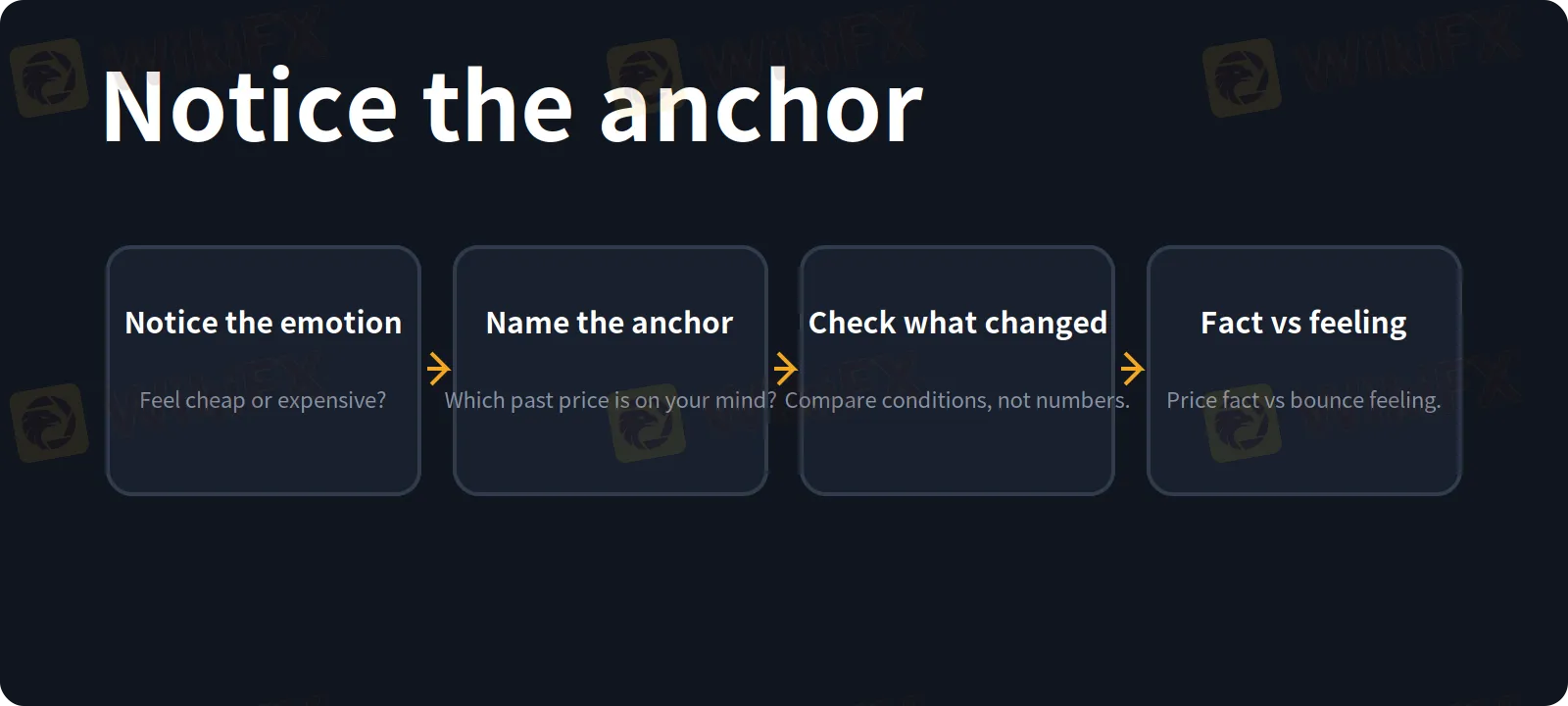
A simple four-step way to catch an anchor before it shapes a judgment.
Anchoring is not a prediction
Anchoring tells you nothing about where a price will go next. A remembered level is not a promise, and it does not become a signal just because you noticed it. Some charts show price levels that many traders watch, and those levels can become meaningful when participants react to them. But that meaning comes from fresh behaviour, not from the number itself.
A learner's job is to notice the anchor and then put it aside long enough to ask what the current market data says. You do not need to fight the feeling of 'cheap' or 'expensive.' You only need to be honest about where that feeling came from.
Disclaimer:
The views in this article only represent the author's personal views, and do not constitute investment advice on this platform. This platform does not guarantee the accuracy, completeness and timeliness of the information in the article, and will not be liable for any loss caused by the use of or reliance on the information in the article.
WikiFX Broker
Latest News
WikiFX Wishes You a Blessed Maulidur Rasul
WikiFXWhat Your Trading Journal Really Reveals About Your Behaviour
WikiFXHe Worked Hard and Saved Money Frugally, Now A Scammer Took It All
WikiFXForex trading psychology: why old prices stick in your mind
WikiFXEMIRAX MARKETS Review: Withdrawal Blocks, Suspended Login Access, and a High-Risk Broker Warning
WikiFXRev One Trading Shuts Down as Founder Shifts Focus to Prediction Markets
WikiFXSaracenMarkets Review 2026: Regulation, High Leverage, and Mixed User Signals
WikiFXUnemployed Man Loses RM516,000 Life Savings to Fake Online Investment Scam
WikiFXLove Scams Now Use AI to Steal Your Heart and Savings
WikiFXYour Trading Journal is a Mirror: How to Spot Behaviour Patterns
WikiFX